
Table of Contents
Many clinic owners spend years improving their clinical skills but very little time improving how the clinic actually runs. The result is a practice that is busy on paper but stressful to manage and unpredictable in profit.
Learning how to run a profitable private clinic is not about hiring more staff or spending more on advertising. It is about identifying where the clinic quietly loses time and revenue every day and fixing those workflows one at a time. Learning how to run a profitable private clinic starts with fixing the systems that quietly lose money every day
In 2026, the private clinics that grow steadily are the ones that treat operations as seriously as they treat patient care. They track the right numbers, automate routine tasks, build follow-up habits, and use tools that support the team instead of creating more work.
This guide breaks down the real operational foundations of a profitable private practice. Whether you are a solo GP, a physiotherapist, a therapist, or a small clinic owner, these systems apply directly to your daily workflow.
Why most clinics stay busy but never feel profitable
There is a big difference between a busy clinic and a profitable clinic. A busy clinic has appointments. A profitable clinic collects on those appointments, reduces waste, retains patients, and controls costs.
Most private practice owners who struggle with profitability are not short on patients. They are short on systems. Their no-show rate is higher than it should be. Their billing is slow. Their follow-up is inconsistent. Their admin team is doing manual work that should be automated.
That is why understanding how to run a profitable private clinic starts with an honest look at operations, not revenue targets.
The five revenue leaks draining your clinic
These five problems appear in almost every small private clinic. They are often invisible because they happen in small amounts every day. Over a year, the loss is significant.
1. No-shows and late cancellations
Every missed appointment is a revenue loss. The slot was reserved, the practitioner was available, and the clinic did not get paid. If reminders are sent inconsistently or not at all, this problem repeats indefinitely.
Automated reminders via WhatsApp, SMS, or email are the single fastest way to reduce this leak. Most patients do not skip visits intentionally. They forget, get distracted, or lose the details. A well-timed reminder solves all three. A clinic that understands how to run a profitable private clinic knows that reducing no-shows is one of the fastest ways to protect revenue.
For a deep dive on this, read our guide on how to reduce patient no-shows.
2. Billing delays
A clinic with 30 patients a week that invoices two days late is losing cash flow every month. When billing depends on manual steps, it gets delayed whenever the front desk is busy. One of the clearest signs of how to run a profitable private clinic is when billing, reminders, and collections happen without unnecessary delays
The fix is a billing workflow that triggers automatically from the appointment. Invoice, collect, record. That cycle should be fast, consistent, and visible.
For more detail, read our guide on the clinic billing checklist: how to get paid faster.
3. Missed follow-ups
Most patients need more than one visit. A physiotherapy patient may need six sessions. A therapy patient may need monthly check-ins. A GP patient may need a review in three weeks.
If the clinic does not have a structured way to bring patients back, a large share of potential revenue disappears. Retention is where many clinics lose money silently. If you are serious about how to run a profitable private clinic, you need one reliable follow-up system for every recurring patient.
Read our guide on how to create a patient follow-up system for your clinic for a step-by-step approach.
4. Front desk errors
Double bookings, missing records, wrong payment notes, and incorrect appointment times all create hidden costs. They waste staff time, frustrate patients, and create correction cycles that slow everything down.
These errors usually happen when the team is using too many disconnected tools. Consolidating into one workflow reduces this problem significantly.
5. Poor package tracking
If your clinic offers recurring care, treatment packages are one of the best ways to improve revenue predictability. But if sessions are tracked manually or not tracked at all, you lose visibility on renewals, usage, and revenue timing.
To learn how to structure this properly, read our guide on how to set up session packages in clinic management software.
Operations benchmarks for a healthy clinic
Every clinic is different, but profitable clinics tend to share a few common operational characteristics. These are useful benchmarks to compare against.
A well-run small clinic usually has:
- a no-show rate below 10 to 15 percent,
- invoices sent within 24 hours of the appointment,
- at least 40 to 60 percent of patients returning for a second visit,
- a clear follow-up system for all recurring care patients,
- one central place where appointments, notes, and billing live together,
- weekly visibility into revenue, bookings, and outstanding payments.
If you are missing several of these, the issue is almost always operational rather than a marketing or demand problem.
How to build a patient retention system
Retention is where the compounding power of a good private practice starts. Acquiring a new patient is always more expensive than keeping an existing one. That makes retention one of the most direct private practice profitability tips available.
A simple retention system has three layers.
Layer 1 — At booking: Confirm the appointment immediately and set expectations for the next step.
Layer 2 — After the appointment: Send a follow-up message, recovery instruction, or next-visit recommendation depending on the treatment.
Layer 3 — Before the patient goes cold: Trigger a reactivation message for patients who have not returned in a defined period. This is often how clinics recover revenue they thought was lost.
This system does not need to be complicated. It needs to be consistent. A clinic that follows up well retains more patients, earns more referrals, and builds a more stable revenue base.
Clinic scheduling efficiency and how it affects profit
Every hour of practitioner time that goes unbooked is revenue that cannot be recovered. That is why clinic scheduling efficiency is not just an administrative metric. It is a profitability metric.
Efficient scheduling means:
- fewer gaps between appointments,
- lower no-show impact through confirmations,
- clear practitioner availability for front desk staff,
- no double bookings or confusion,
- faster rebooking when a cancellation happens.
For a solo practitioner, scheduling efficiency can mean the difference between a full and a half-empty day. For a multi-practitioner clinic, it determines whether the business grows smoothly or creates chaos as headcount increases.
Read our guide on patient scheduling software for a detailed look at what to look for.
How to reduce clinic admin costs without cutting care
Admin costs are often invisible because they show up as staff time rather than direct expenses. But every hour a receptionist spends on manual tasks is an hour not spent on higher-value work.
The best ways to reduce clinic admin costs are:
- automate appointment reminders instead of calling patients manually,
- generate invoices from appointments instead of creating them by hand,
- use one system for booking, records, and billing instead of three,
- set follow-up triggers that run without staff input,
- create templates for messages so replies are fast and consistent.
These changes do not reduce the quality of care. They reduce the friction around it.
How Clindesk supports clinic profitability
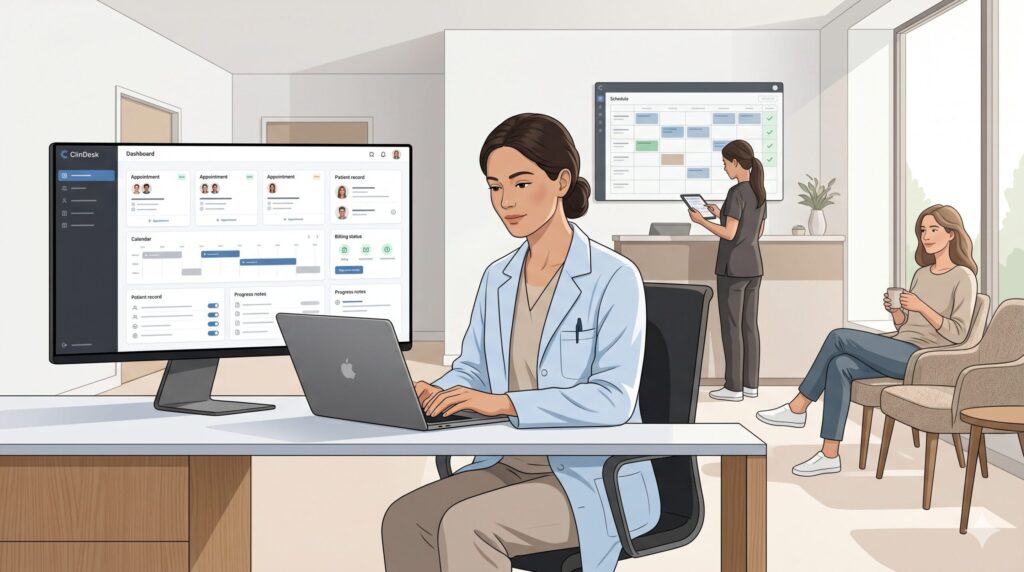
Clindesk is built for small and independent clinics that want to run more efficiently without adopting a heavy enterprise platform. It helps keep scheduling, reminders, follow-up, and communication organized in one workflow.
For clinic owners learning how to run a profitable private clinic, the value of Clindesk is in what it removes rather than what it adds. Less switching between tools. Fewer missed reminders. Fewer forgotten follow-ups. Less billing confusion.
It is not the whole answer to profitability, but it is a practical operational layer that makes the daily clinic workflow easier to sustain. For clinics that are still building their workflows, Clindesk can support how to run a profitable private clinic by keeping scheduling, reminders, and follow-up in one place.
You can explore how it fits your practice size and workflow at clindeskapp.com.
For more context on how clinic software fits into daily operations, read our guide on medical billing software for small clinics.
Scaling from solo to multi-practitioner
Growth changes the operational challenge. What worked with one practitioner becomes messy with three or five.
When a clinic expands, the new priorities become:
- shared calendar visibility,
- clear patient ownership per practitioner,
- standardized billing across all staff,
- assigned follow-up responsibility,
- practitioner-level performance reporting,
- role-based access so staff only see what they need.
This is where practice management for growing clinics matters most. Structure does not slow growth. It enables it.
Many clinics that struggle after growth are not short on patients. They are short on clarity. Their workflows were built for one person and never updated for a team. Understanding how to run a profitable private clinic becomes even more important as the practice grows and more staff members need clear workflows.
Read our guide on how to start a private practice for context on building this structure from day one.
And if your clinic is already established, read how to increase clinic revenue for more specific tactics you can implement immediately.
Useful external tools
For accounting and bookkeeping, Xero is widely used by independent clinics in the UK and Australia and integrates well with most clinic management platforms.
For UK clinics that handle patient data, the ICO’s guidance on data protection is the definitive reference for understanding your legal obligations around patient records and software compliance.
A practical operations checklist
Before you invest in any system or hire additional staff, use this checklist:
- No-show rate is tracked and below 15 percent.
- Reminders go out automatically for every appointment.
- Invoices are created within 24 hours of the appointment.
- Follow-up is triggered for all recurring care patients.
- Package usage is visible and renewal reminders are set.
- Staff use one central system for booking, notes, and billing.
- Weekly metrics are reviewed by the clinic owner.
- Patient retention is tracked over at least 90 days.
The real answer to how to run a profitable private clinic is not more pressure on the team — it is better systems that make the clinic easier to run every day. If most of these are ticked, your clinic has a healthy operational foundation. If several are missing, that is where to focus before adding more marketing or staff.
FAQs
How to run a profitable private clinic in 2026?
Focus on reducing no-shows, improving billing speed, retaining patients longer, and simplifying admin so the clinic earns more from existing capacity.
What is the fastest way to increase clinic revenue?
Reducing no-shows and improving follow-up are usually the fastest wins because they increase revenue without increasing marketing costs.
How can I reduce clinic admin costs?
Automate reminders, generate invoices from appointments, and consolidate your workflow into one system instead of several disconnected tools.
What are the biggest revenue leaks in a private clinic?
No-shows, billing delays, missed follow-ups, front desk errors, and poor package tracking are the five most common leaks.
What is clinic scheduling efficiency and why does it matter?
It is how well your clinic fills and manages appointment slots. Poor scheduling means gaps that cannot be recovered.
How do session packages improve profitability?
Packages create predictable revenue, improve patient commitment, and make it easier to track renewals and follow-ups.
What should a private clinic track every week?
Bookings, no-show rate, revenue collected, outstanding invoices, repeat visits, and follow-up completion rate.
Is Clindesk suitable for a solo physiotherapy practice?
Yes. It helps solo clinics stay organized with scheduling, reminders, and patient communication without enterprise complexity.
How do I build a patient retention system from scratch?
Start with three triggers: a booking confirmation, a post-visit follow-up, and a reactivation message for patients who stop returning.
What does practice management for growing clinics look like?
It includes shared scheduling, clear patient ownership, standardized billing, assigned follow-up, and role-based access for staff.
When should a clinic invest in practice management software?
When manual processes are causing missed appointments, billing delays, or inconsistent follow-up, it is time to invest in better systems.
Can a clinic be profitable with only 10 to 20 patients a week?
Yes, if the clinic has low no-shows, fast billing, and good retention. Small volume with good operations is more sustainable than high volume with bad systems.
What is the best way to reduce no-shows in a private clinic?
Send an appointment reminder 24 to 48 hours before the visit via WhatsApp, SMS, or email. This alone significantly reduces missed attendance.
How does Clindesk help with billing?
Clindesk connects scheduling and billing so invoices can be created faster and front desk confusion around payment is reduced.
Is it better to hire more front desk staff or improve systems first?
Almost always improve systems first. Better systems reduce the workload so effectively that many clinics find they need less manual support, not more.